
Micromobility sounds small when discussed in policy rooms, but anyone who has watched a neighborhood wake up knows it is not. I learned that sitting in traffic meetings where every line on a map was really a family, a job, or a tired pair of legs trying to get home. Cities do not move in averages. They move in habits, in weather, in the quiet choices people make when nobody is watching.
A city reveals itself in the small choices people make as they move through it. Who walks the last block. Who rides a bike instead of driving. Who waits for a bus because it feels worth the time. Those choices draw a truer map than any planner ever could. They show where a place feels human and where it does not.
Copenhagen did not become a cycling city by accident. It chose to take space from cars and give it back to people, and that choice changed how the city thinks about itself. Movement stopped being only about speed and started being about belonging. That idea stays with me. I build things for cities, and that is why micromobility holds my attention.
Micromobility is the class of vehicles that replace short car trips. E-bikes that carry commuters. Cargo trikes that move goods. Scooters and bikes that move people through the dense parts of a city. Close to the ground, quiet enough to hear a conversation, moving at the speed of a human body, not a highway. It is not about devices; it is about shifting how streets, parking, and energy are used.
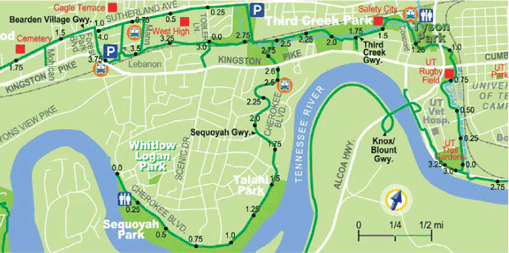
Knoxville is the place for this shift to grow. The river traces the heart of the city. Over 125 miles of greenways reconnect neighborhoods. The Old City holds its brick-and-rail lines with pride, a reminder that movement has always shaped this place. People know their streets. They know the weave of old roads, the footpaths along the creeks, and the measure of a town sized for walking. UT adds its own pulse, 40,000 students moving through the city each day.
We have a depth that surprises people. The National Transportation Research Center studies the future of movement with the strength of Oak Ridge and the University of Tennessee behind it. TEAM TN adds its own momentum as the state leans into electrification and new forms of mobility. All that ambition leaves space for smaller, quieter shifts, the ones that change how a city moves. Knoxville is large enough to matter and close enough to feel.
The market is ready. Global micromobility reached $40 billion in 2024 and is expected to more than double by 2030. E-bikes account for 90% of that value. North America is growing fastest, outpacing Europe and Asia at more than 16% annually. Nearly 50% of consumers in a McKinsey survey said they would consider giving up a private vehicle within the next decade. It is not a fad; it is the result of a generation choosing access over ownership and proximity over sprawl.
This is what makes Spark Mobility different. We train founders in techno-economic and life cycle analysis, the discipline that turns intuition into clarity. That clarity lets them build what cities need next: the smaller, steadier shifts that change how we move.
Spark Mobility Lab is for teams building the physical systems that move people and goods, bikes, vehicles, components, charging, and the infrastructure around them. If you need economic proof to reach your next technical or commercial milestone, this week is built for that.
One week in Knoxville.
Techno-economic analysis to show whether your design can make money at scale.
Life cycle analysis to show whether it delivers the energy and emissions outcomes your customers and regulators care about.
No cost to participate.April 20–25, 2026
Up to eight teams, typically at TRL 4–6, with a working prototype or subsystem.Apply Here: https://www.f6s.com/spark-mobility-lab/apply